Landlord Tools
Net Effective Rent: What It Means and How to Calculate It

Net effective rent (NER) is the average rent you pay (or collect) per period once free months and other concessions get spread across the full lease term. The quick formula: NER = (Total rent due over the lease term − value of concessions) ÷ total lease periods. Lenders like Fannie Mae and Freddie Mac routinely adjust reported rents for concessions when underwriting multifamily deals, because the advertised rate rarely matches what actually lands in the bank. A tool like CashflowCalcs can run this math for you and show the worked example behind the number.
- NER is a per-period average, not a bill amount
- It exists to make concession-heavy leases comparable to concession-free ones
- Landlords, tenants, brokers, and appraisers all use it, but for different decisions
Key Takeaways
Net effective rent equals total rent due minus concessions, divided by the number of lease periods, and it always runs lower than the gross monthly check tenants actually pay.
| Point | Details |
|---|---|
| Use the right formula | Apply the simple amortized formula for most leases; reserve discounted cash flow math for multi-year commercial deals with front-loaded concessions. |
| NER is an average, not a bill | The gross monthly check in paid months is almost always higher than the advertised net effective rent. |
| Know what counts as a concession | Free months, TI credits, and waived fees count; one-time gifts that don’t touch the rent ledger don’t. |
| Renewals reset to face rent | Confirm lease language before assuming your renewal will honor the discounted NER rate. |
| Verify with a transparent calculator | Cashflowcalcs shows the formula and a worked example for every result, so you can check the math on any lease comparison. |
Table of Contents
- What Does Net Effective Rent Measure, and Why Does It Exist?
- Net Effective Rent Calculation: Two Formulas You Can Use
- How Do You Calculate Net Effective Rent Step by Step?
- Gross Rent vs. Net Rent: What You Actually Pay Each Month
- Who Actually Uses Net Effective Rent, and When?
- Which Lease Items Count as Concessions?
- Common Pitfalls and Negotiation Tips
- Calculator Options for Computing Net Effective Rent
- Run Your Own Numbers Before You Sign or List
- Sources
- FAQ
What Does Net Effective Rent Measure, and Why Does It Exist?
For a landlord, net effective rent measures the true average income a unit generates once concessions are amortized across the lease. For a tenant, it measures the real average cost of occupying the space, not the number printed on the listing. Both are looking at the same math from opposite sides of the ledger.
Concessions exist partly because face rent (the advertised, contractual rate) anchors renewals and comps. A landlord who cuts the sticker price permanently resets the baseline for every future lease and every appraisal in the building. Offering a free month instead keeps the face rent intact while delivering the same first-year discount, a distinction the Steadily research on gross versus net rent points to directly.
- A typical example: a unit with one free month on a 12-month lease has an NER lower than the $2,000/month face rent, but the face rent remains $2,000
- A landlord who instead cuts the rent to $1,900/month permanently: the new face rent becomes $1,900, affecting every future comp
Net Effective Rent Calculation: Two Formulas You Can Use
The simple formula covers almost every residential lease and most short commercial ones:
NER = ((Monthly rent × lease months) − concession value) ÷ lease months
Here, monthly rent is the contractual face rate, lease months is the total term, and concession value is the dollar amount of free rent, credits, or abatements built into the deal. This is the version BubbleGum BI’s guide to calculating net effective rent recommends for quick, portfolio-level reporting.
For longer commercial leases or deals with front-loaded concessions (a big tenant improvement allowance in year one, for example), a rigorous version discounts each period’s cash flow to present value before averaging, since a dollar of free rent today is worth more than a dollar of free rent in year five, per the Wikipedia entry on net effective rent.
- Use the simple formula for residential leases and short commercial terms
- Use the discounted cash-flow version for multi-year leases with large, front-loaded TI allowances
Pro Tip: If concessions total less than one month on a lease under three years, the simple formula and the discounted version will land within a rounding error of each other. Save the discount-rate math for leases where the difference actually moves the valuation.
How Do You Calculate Net Effective Rent Step by Step?
Residential example. A tenant signs a 12-month lease at $2,400/month with one free month.
- Total face rent: $2,400 × 12 = $28,800
- Concession value: one free month = $2,400
- Net rent collected: $28,800 − $2,400 = $26,400
- NER: $26,400 ÷ 12 = $2,200/month
The tenant sees “$2,200/month effective” in the listing, but writes $2,400 checks for 11 months and $0 for one, matching how StreetEasy explains net effective rent to NYC renters.
Commercial example. A tenant signs a 5-year (60-month) lease at $30/psf/year on a 2,000 sq ft space, with a $50,000 TI allowance and two months of rent abatement.
- Total face rent: $30/psf × 2,000 sq ft = $60,000/year × 5 years = $300,000
- Abatement value: 2 months × $5,000/month ($60,000 ÷ 12) = $10,000
- TI allowance treated as a rent credit: $50,000
- Net rent collected: $300,000 − $10,000 − $50,000 = $240,000
- NER: $240,000 ÷ 60 months = $4,000/month, or $24/psf/year
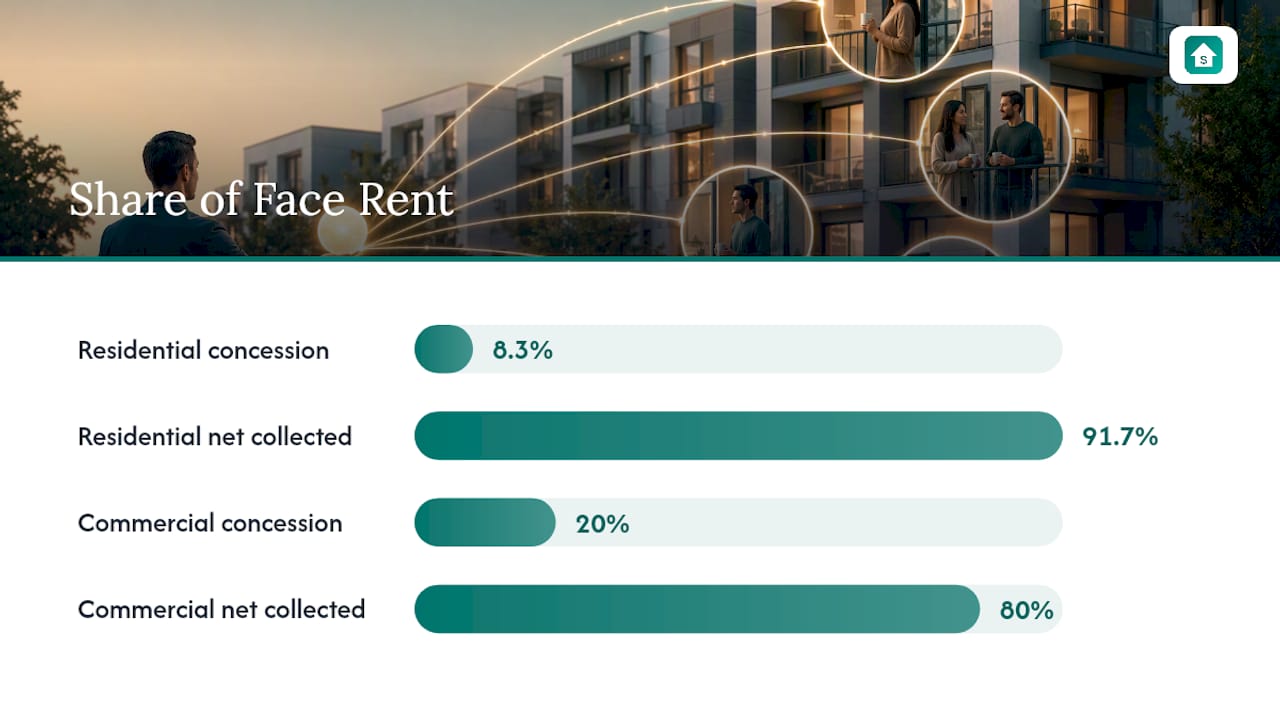
That’s a 20% discount from the $30/psf face rate.
To back-calculate a gross monthly check from a published NER, multiply NER by total lease months, then divide by the number of months you’ll actually pay. In the residential example: $2,200 × 12 = $26,400 total, divided by 11 paid months = $2,400/month, exactly what the lease requires.
| Item | Residential (12 mo.) | Commercial (60 mo.) |
|---|---|---|
| Total face rent | $28,800 | $300,000 |
| Total concessions | $2,400 | $60,000 |
| Net rent collected | $26,400 | $240,000 |
| Net effective rent | $2,200/month | $4,000/mo ($24/psf/yr) |
| Discount from face rent | 8.3% | 20% |
Gross Rent vs. Net Rent: What You Actually Pay Each Month
The mismatch trips up plenty of renters and investors: an advertised NER of $2,200 is not a monthly bill. It’s an average. The lease still specifies a gross monthly payment, and in the residential example that’s $2,400 for 11 of 12 months.
To convert an advertised NER back into a real monthly check, multiply the NER by the lease term, then divide by the number of months you’ll actually pay rent. Renewals typically reset to the gross (face) figure, not the effective one, unless the lease explicitly states otherwise, a pattern Brick Underground’s breakdown of net effective versus gross rent confirms is standard practice.
- Advertised NER answers “what’s the average deal worth?”
- Gross rent answers “what check do I write this month?”
Who Actually Uses Net Effective Rent, and When?
Appraisers, lenders, and portfolio managers rely on NER for net operating income calculations, valuations, and discounted cash flow models, since concession-adjusted income reflects what a property truly earns, as explained in this Cash-Out Refinance for Commercial Real Estate | Brookmont Capital Ventures resource. Brokers use it to compare competing listings that structure discounts differently. Landlords track NER against gross rent across a portfolio because a widening gap between the two signals growing concession reliance and a softening submarket, a signal worth watching in the BubbleGum BI multifamily guide.
Gross rent still governs monthly rent collections, statutory security deposit caps in most states, and broker commission calculations, which are typically based on face rent, not the effective figure.
- Underwriters commonly subtract concessions from gross potential rent before calculating NOI
- A free month on a 12-month lease reduces effective rent by roughly 8.3%, and the percentage impact grows as lease terms shorten
Which Lease Items Count as Concessions?
Not every perk landlords hand out belongs in the NER calculation. The test is simple: does it reduce rent on the ledger?
Include:
- Free rent months
- Tenant improvement allowances credited as rent offsets
- Flat dollar-off monthly discounts
- Stepped rents priced below the long-term face rate
- Waived recurring fees (parking, storage, amenity charges)
Exclude (unless it reduces ledger rent): one-time gift cards, welcome baskets, or move-in gifts that never touch the rent roll, according to CommLoan’s research on net effective rent.
For a partial-month concession (say, two weeks free rather than a full month), prorate it: divide the monthly rent by days in the month, multiply by the free days, and subtract that dollar figure from total rent due.

Common Pitfalls and Negotiation Tips
Watch for listings that publish only NER without disclosing the gross monthly check or clarifying which specific months are free. That’s a red flag, especially in markets where StreetEasy’s transparency push has made side-by-side gross and net figures the norm.
Before signing, confirm three things in writing: which month(s) are free, whether the security deposit is calculated on gross or net rent, and your worst-case monthly obligation if you break the lease early and forfeit the concession.
- Ask for the exact lease clause governing the concession
- Confirm the deposit calculation base (usually gross, not net)
- Calculate your worst-case monthly check before signing
For landlords, free-month concessions preserve face rent for comps and renewals while delivering the same first-year cash impact as a permanent cut. That’s why most operators default to temporary concessions in softening markets rather than resetting the headline rate.
Pro Tip: If you’re a landlord choosing between a free month and a permanent discount, run both scenarios through your NOI projection before deciding. The cash impact is identical this year, but only one of them follows you into next year’s renewal.
Calculator Options for Computing Net Effective Rent
Simple online calculators handle the amortized formula fine for a single residential lease or a straightforward commercial deal. Valuation-grade discounted cash flow calculators matter more for multi-year commercial leases with front-loaded TI allowances, since timing changes the real value of the concession.
A calculator worth trusting shows its formula, lets you input TI allowances and stepped rent separately, and walks through a worked example so you can check the math yourself instead of accepting a black-box number.
- General consumer calculators (like Omni Calculator) handle quick residential NER math
- Rental-specific tools such as the Fancy Apartments net effective rent calculator focus on apartment-listing scenarios
- Commercial real estate resources like Adventures in CRE cover the discounted cash-flow version for valuation work
- CashflowCalcs runs entirely in your browser, requires no sign-up, and shows the formula and a worked example next to every result so you can verify the output line by line
Run Your Own Numbers Before You Sign or List
Every example above shows the same lesson: the number on the listing and the number you’ll actually pay can differ by hundreds of dollars a month once concessions get involved.
Instead of reconstructing that arithmetic by hand every time you compare two leases, the Rental Property Comparison Calculator at Cashflowcalcs lets you enter concession terms for multiple properties side by side and see the net effective rent, gross monthly check, and annualized cost for each. If you’re working through a single lease instead, the Rental Property Calculator breaks out TI allowances, free months, and stepped rent individually so you can see exactly how each concession moves your bottom line. Every calculator runs free in your browser, with no sign-up, and shows its formula and a worked example next to the result. This tool is for educational estimates only, not tax, legal, or investment advice. Consult a qualified professional for decisions specific to your lease or portfolio.
Sources
- Net effective rent - Wikipedia
- Net Effective Rent: What Does It Mean and How Much Do You Really Pay? - StreetEasy
- Net Effective Rent: How to Calculate & Use It in Multifamily | BubbleGum BI
- What is net-effective rent vs. gross rent? - Brick Underground
This article is general information, not a substitute for advice from a qualified financial advisor. Consult a qualified financial professional about your own circumstances before acting on anything here.
FAQ
How do you calculate net effective rent?
Multiply the monthly face rent by the total lease months, subtract the dollar value of concessions, then divide by the total lease months. A 12-month lease at $2,400 with one free month yields an NER of $2,200/month.
What does $20 sf nnn mean?
It means $20 per square foot per year under a triple net (NNN) lease, where the tenant pays base rent plus property taxes, insurance, and maintenance separately. That $20/psf figure is the face rate before any concessions are applied to calculate NER.
Do you pay the net effective rent?
No. You pay the gross monthly rent specified in the lease during paid months; net effective rent is only the averaged figure used for comparison and reporting, not an actual bill amount.
How much should my rent be if I make $60,000 a year?
A common budgeting guideline caps rent at roughly 30% of gross income. Use gross rent, not an advertised net effective rent, when running this calculation, since that’s the figure you’ll actually pay most months.