Taxes
When U.S. Hosts Owe Self Employment Tax for Airbnb: $3,532 Example

Most Airbnb hosts owe no self-employment tax at all, because rental income is excluded from it by default under IRC §1402(a)(1). That changes the moment you provide “substantial services” for guest convenience, which turns you into a lodging business filing Schedule C instead of Schedule E. Rent your place for 14 days or less in a year, and the income may not even need to be reported.
TL;DR:
- Renting out your property for 14 days or less per year generally exempts the income from reporting, unless you provide substantial guest services.
- Providing daily housekeeping, meal preparation, or arranging transportation can trigger self-employment tax, forcing income onto Schedule C and Schedule SE.
- Maintaining minimal services like utilities, maintenance, and routine cleaning keeps your rental classified as landlord income, avoiding self-employment tax.
- Proper recordkeeping of services provided, including guest messages and receipts, is essential for IRS compliance and correct classification.
- Co-ownership and platform reporting do not automatically change your tax status; substantial services determine if self-employment tax applies, regardless of ownership or 1099 forms.
Table of Contents
- Airbnb Self Employment Tax: The Substantial Services Test That Decides Everything
- Schedule E, Schedule C, and When You Need Schedule SE
- The Worked Example: What Substantial Services Actually Costs You
- Special Rules That Can Change or Eliminate Your Filing Obligation
- Recordkeeping That Protects Your Classification
- Jointly Owned Airbnb Properties and Self-Employment Tax
- State Income Tax and Self-Employment Tax Do Not Move Together
- Property Managers and Third-Party Platforms Change the Analysis
- Legal Ways to Reduce Your Self-Employment Tax Exposure
- Sole Proprietorship vs. LLC: What Actually Changes for SE Tax
- Model Your Numbers Before You File
- Sources
- FAQ
Airbnb Self Employment Tax: The Substantial Services Test That Decides Everything
The IRS draws a hard line between a landlord and a hotelier, and that line is called the “substantial services” test. Topic No. 414 states plainly that rental income from real estate is excluded from self-employment tax unless you’re operating as a real estate dealer or providing substantial services for the convenience of your occupants. Treasury Reg. §1.1402(a)-4 and the Tax Court cases interpreting it are fact-specific, which means there’s no single checklist that decides your case for you. Instead, IRS guidance and legal memoranda look at what you actually do for guests during their stay.
Certain services tend to push a host across the line:
- Daily or mid-stay housekeeping while a guest is still in the unit
- Preparing or serving meals
- Arranging transportation, tours, or concierge-style services
- Changing linens or restocking supplies partway through a stay
Other tasks stay firmly in landlord territory, according to tax guidance comparing Schedule C and Schedule E treatment:
- Cleaning the unit between guest turnovers
- Providing utilities, Wi-Fi, or basic appliances
- Routine maintenance, like replacing a light bulb or fixing a leaky faucet
- Stocking the unit before a guest arrives (not during their stay)
Run through this six-point self-check: Do you clean only between stays, or also during them? Do you provide food? Do you book activities or drive guests anywhere? Do you swap towels or linens mid-stay? Do you offer anything resembling hotel amenities (daily breakfast, turndown service)? Does your listing market itself as a “hosted experience” rather than a rental?
Pro Tip: Keep your listing description and guest communications consistent with landlord-only services. If your Airbnb copy brags about “daily housekeeping” or “personal concierge,” that language alone can support an IRS argument that you’re running a lodging business, regardless of what actually happens.
Schedule E, Schedule C, and When You Need Schedule SE
Once you’ve applied the substantial services test, the form you file follows automatically. If your rental qualifies for the §1402 exclusion, you report income and expenses on Schedule E, and none of that profit touches self-employment tax, no matter how large it is.
If you’re providing substantial services, you’re running a trade or business, and that income belongs on Schedule C. From there, the rule is simple: if your net earnings from self-employment hit $400 or more, you must file Schedule SE to calculate what you owe.
Here’s what Schedule SE actually does with your numbers:
- It multiplies your net earnings by 92.35% to get your SE tax base
- It applies a combined 15.3% rate to that base (12.4% for Social Security, 2.9% for Medicare)
- The 12.4% Social Security portion only applies up to the annual wage base, which the Social Security Administration adjusts each year
- The 2.9% Medicare portion applies to all net earnings, with an additional 0.9% Medicare surtax kicking in above $200,000 for single filers ($250,000 married filing jointly)
One important distinction: the substantial services test for SE tax is completely separate from the material participation rules that determine passive activity loss limits. You can materially participate in your short term rental business for loss purposes and still fall under the §1402 exclusion for SE tax purposes. They’re different tests answering different questions.
The Worked Example: What Substantial Services Actually Costs You
Numbers make this real. Say you net $40,000 in gross Airbnb revenue for the year and claim $15,000 in expenses (cleaning, supplies, mortgage interest, property tax, and depreciation), leaving a $25,000 net profit.
| Line item | Schedule E (no substantial services) | Schedule C (substantial services) |
|---|---|---|
| Gross rental revenue | $40,000 | $40,000 |
| Deductible expenses | $15,000 | $15,000 |
| Net profit | $25,000 | $25,000 |
| Self-employment tax base (92.35% of net profit) | Not applicable | $23,087.50 |
| Self-employment tax (15.3% of base) | $0 | $3,532.39 |
| Income tax exposure | Applies to $25,000 | Applies to $25,000 minus half of SE tax deduction |
The Schedule E host keeps the full $25,000 exposed only to ordinary income tax. The Schedule C host owes an additional $3,532.39 in self-employment tax on top of income tax, though half of that SE tax amount becomes an above-the-line deduction that reduces taxable income slightly.
Not every deduction affects both tax bases equally. Depreciation, mortgage interest, and property tax reduce your net profit, which lowers both income tax and SE tax exposure if you’re on Schedule C. But some hosts miss that the Rental Property Depreciation Calculator can model exactly how depreciation shifts your net profit before you even decide which schedule applies to you.
If your net earnings from self-employment were high enough to exceed the Social Security wage base for the year, only the portion up to that cap gets the 12.4% Social Security tax; earnings above it still owe the 2.9% Medicare portion. That’s a meaningful planning point for hosts with multiple substantial-service properties generating six-figure profits.
Special Rules That Can Change or Eliminate Your Filing Obligation
A handful of exceptions reshape this picture entirely, and missing them means either overpaying or under-reporting.
- The 14-day rule (sometimes called the Augusta rule): if you rent your home for 14 days or fewer during the year, that income is generally tax-free and doesn’t need to be reported on your federal return at all. Rent it for 15 days or more, and all of it becomes reportable.
- Dealer status: if the IRS considers you a real estate dealer, meaning you buy and sell properties as inventory rather than hold them for rental, the §1402 exclusion doesn’t protect you even without substantial services.
- Qualified Joint Venture (QJV) treatment: married co-owners electing QJV status split income and expenses between two Schedule Cs or Schedule Es, but this doesn’t change whether substantial services trigger SE tax in the first place.
- Platform reporting (1099-K): 1099-K reporting thresholds from Airbnb have shifted in recent years, but receiving one doesn’t determine your SE tax liability. That’s decided by the substantial services test, not by what a platform reports to the IRS.
State and local lodging or occupancy taxes are a separate matter entirely, governed by state law rather than federal tax code, and they don’t affect your federal self-employment tax calculation either way.
Recordkeeping That Protects Your Classification
The IRS treats the substantial services question as fact-specific, which means your documentation carries real weight if you’re ever questioned.
- Save your listing description exactly as published, since it shows what you promised guests.
- Keep guest message threads showing what services you actually delivered during a stay.
- Log cleaning timestamps, distinguishing clearly between turnover cleanings and any mid-stay service.
- Retain receipts for anything guest-facing: supplies, food, transportation arrangements.
- Track mileage if you drive to the property for maintenance or turnovers, since a reliable mileage tracking system supports both Schedule C and Schedule E deductions.
If you discover you’ve been misclassified, owe significant unpaid SE tax, or receive IRS correspondence questioning your filing, talk to a CPA before amending anything. Pro Tip: Run your numbers through a calculator before you talk to a tax preparer. Walking into that conversation with a clear Schedule E versus Schedule C comparison saves billable time and helps you ask sharper questions.
Jointly Owned Airbnb Properties and Self-Employment Tax
Co-ownership doesn’t erase the substantial services test, but it does change how the resulting tax gets split. If spouses jointly own a property that qualifies for the §1402 exclusion, the income flows through Schedule E and neither spouse owes SE tax on it, regardless of the ownership percentages involved.
Once substantial services apply, joint ownership between spouses in a non-community-property state typically requires the QJV election to divide income and expenses proportionally between two separate Schedule Cs, each with its own Schedule SE. That matters because each spouse’s Social Security earnings record gets credited individually, which can affect future retirement benefits, an upside some hosts overlook when they view SE tax purely as a cost.
For unmarried co-owners (business partners, siblings, or friends who bought a property together), a substantial-services rental typically creates a partnership for tax purposes, requiring Form 1065 and Schedule K-1s rather than a simple split across two Schedule Cs. Each partner then reports their share of net earnings on their own Schedule SE.
The practical takeaway: ownership structure decides who pays, but the substantial services test still decides whether anyone pays SE tax in the first place. Before assuming a co-owned property is protected, confirm that neither owner is providing hotel-like services, since one owner’s actions performed on behalf of the property can affect the classification for everyone with a stake in it. Running the numbers through the Rental Property Comparison Calculator can help co-owners see how different ownership and service arrangements shift the total tax bill.
State Income Tax and Self-Employment Tax Do Not Move Together
Self-employment tax is a federal obligation under Schedule SE, and it applies the same 15.3% combined rate regardless of which state your rental sits in. States don’t impose their own version of “self-employment tax” in the way the federal government does. What varies enormously by state is the income tax layered on top of your net rental profit.
States like Florida, Texas, and Nevada impose no state income tax, so an Airbnb host there pays federal income tax and, if applicable, federal SE tax, with nothing added at the state level. States like California and New York tax rental profit as ordinary income at rates that can exceed 9% or 10% at higher brackets, on top of whatever federal SE tax applies if you’re providing substantial services.
A few states also levy their own transient occupancy or lodging taxes collected separately from income tax, often remitted directly by Airbnb depending on local agreements. Those lodging taxes are a cost of doing business, deductible as an expense, but they’re entirely distinct from both state income tax and federal self-employment tax.
If you operate short-term rentals in multiple states, you may owe income tax in each state where a property is located, not just your state of residence, which typically requires a nonresident state return for each. Your federal Schedule SE calculation stays the same no matter how many states are involved, since it’s based on your combined net earnings from self-employment nationwide. A CPA licensed in each relevant state is worth the cost once you cross into multi-state rental ownership, since state apportionment rules get complicated fast.
Property Managers and Third-Party Platforms Change the Analysis
Hiring a property manager or leaning heavily on Airbnb’s own tools doesn’t automatically flip your tax treatment in either direction, but it does affect how the substantial services test plays out in practice.
If a property manager handles turnover cleaning, maintenance, and guest communication about logistics (check-in codes, Wi-Fi passwords, parking instructions), that still falls on the landlord side of the line. The services being performed matter more than who performs them. A property manager providing daily housekeeping, meals, or concierge-style guest services during a stay creates the same SE tax exposure as if you did it yourself, since the IRS looks at what services the guest actually receives, not who delivers them.
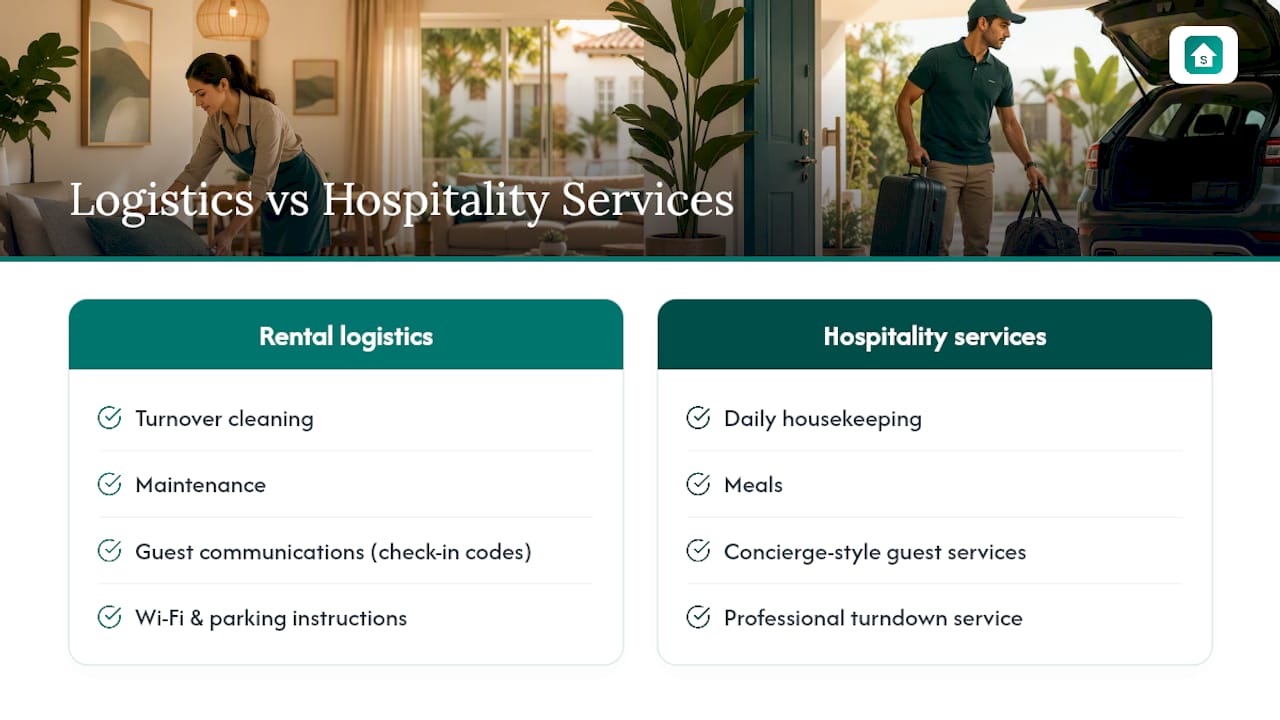
Where this gets more nuanced is full-service property management companies that market “hospitality management,” bundling amenities like professional turndown service, in-unit welcome baskets replenished mid-stay, or arranged local experiences. Those add-ons can push a property into substantial-services territory even if the owner never sets foot on-site.
Airbnb itself doesn’t provide guest-facing services on your behalf, since it’s a booking platform, not a management company. Using Airbnb’s messaging system, smart lock integrations, or dynamic pricing tools has no bearing on the substantial services test at all. The distinction that matters is whether real, hands-on hospitality services are being delivered to guests during their stay, regardless of whether that’s you, a property manager, or a cleaning contractor doing the delivering.
Legal Ways to Reduce Your Self-Employment Tax Exposure
The most direct lever is structuring your operation so services stay on the landlord side of the line. That doesn’t mean stripping your listing of anything that makes it appealing. It means limiting hands-on, guest-facing services during a stay to what a typical landlord would provide, and outsourcing anything that resembles hospitality to a system guests use themselves (self-check-in, a stocked welcome closet available on arrival rather than restocked mid-stay, a local guide document instead of a personally arranged tour).
Maximizing legitimate deductions also lowers your SE tax base if you are on Schedule C, since SE tax is calculated on net profit, not gross revenue. Depreciation is the biggest lever most hosts underuse. Under the One Big Beautiful Bill Act, 100% bonus depreciation is now permanent for qualifying property acquired after January 19, 2025, which can accelerate deductions substantially in the year you place a property or major improvement in service.
For hosts who genuinely qualify for the §1402 exclusion, the cleanest strategy is simply confirming that qualification with documentation, rather than assuming it. Hosts sometimes drift into substantial-services territory gradually, adding a welcome basket here, a mid-stay towel swap there, without realizing they’ve crossed into Schedule C obligations they never intended to take on.
If your operation has genuinely grown into a service-heavy hospitality business, an S-corporation election (available to LLCs and corporations, not sole proprietors) can reduce SE tax by allowing owners to split income between a reasonable salary (subject to payroll tax) and distributions (not subject to SE tax). That move has real complexity and compliance costs, so it’s worth a CPA’s involvement before electing it.
Sole Proprietorship vs. LLC: What Actually Changes for SE Tax
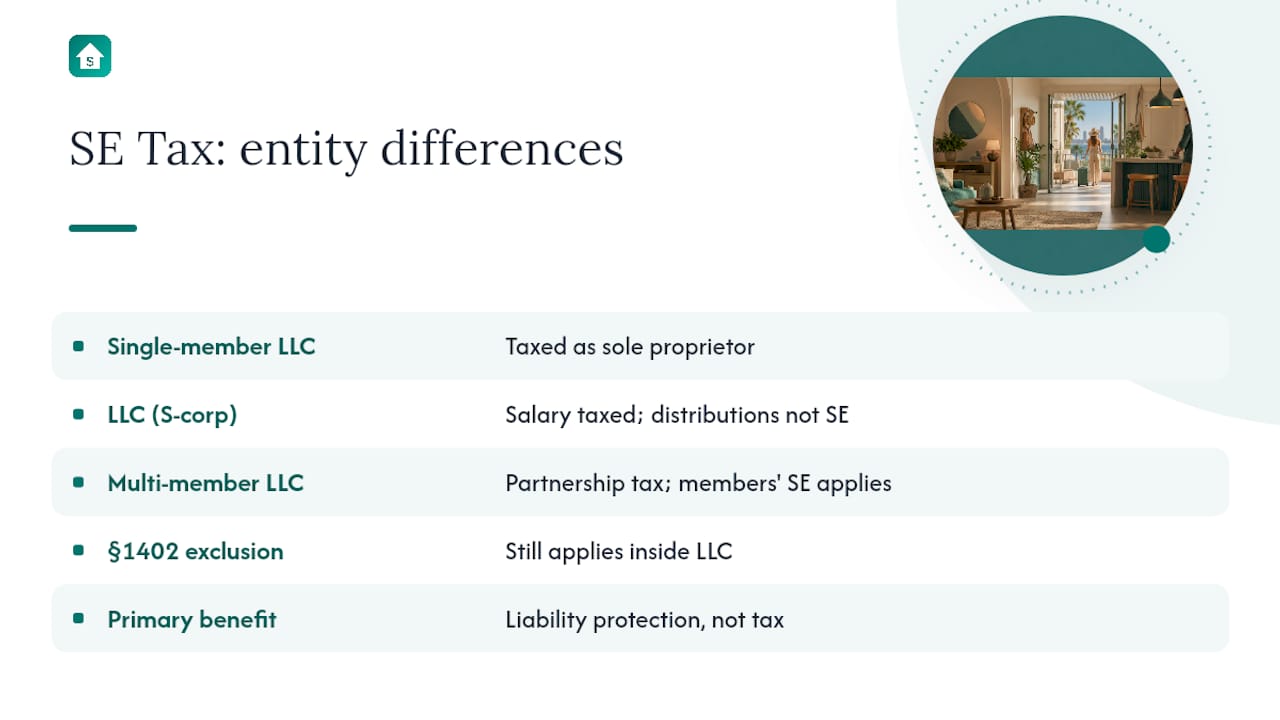
Here’s a distinction that trips up a lot of hosts: forming an LLC does not, by itself, change whether your Airbnb income is subject to self-employment tax. A single-member LLC is a disregarded entity for federal tax purposes by default, meaning the IRS taxes it exactly like a sole proprietorship. If your rental qualifies for the §1402 exclusion, that exclusion still applies inside an LLC. If your services are substantial, Schedule C and Schedule SE still apply inside an LLC too.
What an LLC does provide is liability protection, keeping your personal assets separate from claims related to the rental property. That’s a legal and business consideration, not a tax one, and it’s often the real reason hosts form one.
The tax treatment can change if you elect to have your LLC taxed as an S-corporation, which is a separate decision from simply forming the LLC. Under an S-corp election, you pay yourself a reasonable salary subject to payroll tax, and remaining profit distributed to you as an owner isn’t subject to SE tax. This only makes sense once your substantial-services rental income is large enough to justify the added payroll administration and tax preparation costs, generally when net profit reaches the tens of thousands of dollars annually.
Multi-member LLCs default to partnership taxation, which means Form 1065 and K-1s, with each member’s share of net earnings from a substantial-services rental subject to SE tax on their individual return. The business structure conversation is worth having with a CPA once your Airbnb operation moves from a side rental to something closer to a full-time hospitality business, since the right structure depends on your specific revenue, service level, and long-term goals.
Model Your Numbers Before You File
Reading the rules is one thing. Seeing exactly how they apply to your property is another, and that’s where a lot of hosts get stuck guessing instead of calculating.
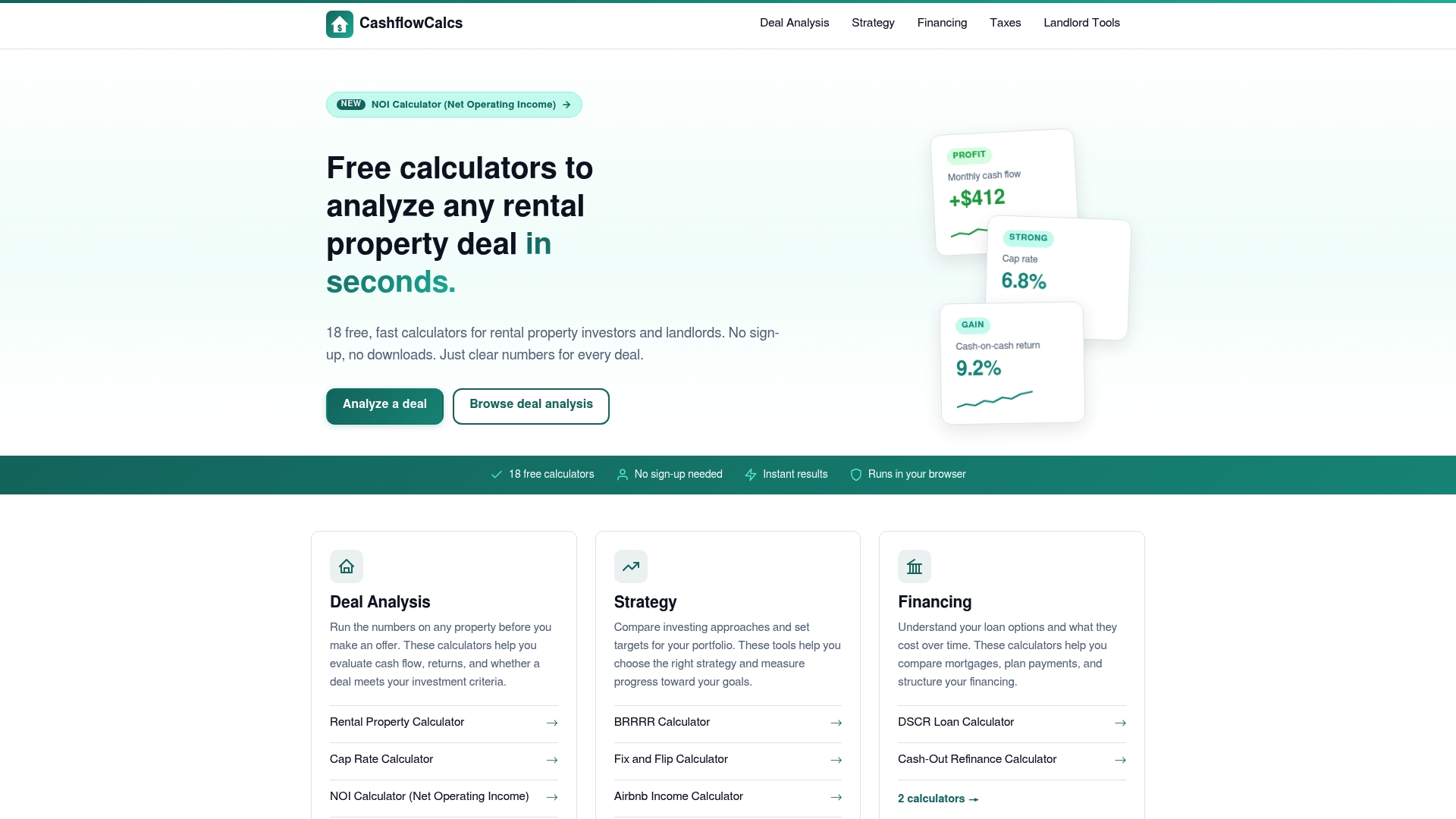
The Airbnb Income Calculator at Cashflowcalcs lets you plug in your actual gross revenue, expenses, and service level, then compare what you’d owe under Schedule E versus Schedule C side by side, using the same 92.35% and 15.3% math from the worked example above. It runs entirely in your browser, requires no sign-up, and shows the formula behind every number so you’re never trusting a black box calculation you can’t verify yourself. If depreciation is part of your expense picture, pair it with the Rental Property Depreciation Calculator to see how bonus depreciation timing shifts your net profit and, in turn, your SE tax exposure.
These tools are built for modeling scenarios, not for filing your return. For anything involving your actual classification, an IRS notice, or an amended filing, talk to a CPA or enrolled agent who can review your specific facts. Consider this educational information, not tax advice.
This article is general information, not a substitute for advice from a qualified financial advisor. Consult a qualified financial professional about your own circumstances before acting on anything here.
FAQ
What is the tax loophole for Airbnb hosts?
The main legal opportunity isn’t a loophole so much as the §1402 exclusion itself: rental income without substantial services skips self-employment tax entirely, and renting your home 14 days or less in a year can make that income tax-free altogether.
What is the 80/20 rule in Airbnb?
There’s no official IRS rule for Airbnb taxation based on specific guest-service percentages. Classification depends on whether you provide substantial services for guest convenience, not on any numerical ratio.
Do I need to pay taxes on my Airbnb income?
Yes, in almost every case. Airbnb income is taxable and must be reported unless you fall under the 14-day rule (renting 14 days or fewer per year), in which case the income is generally tax-free and doesn’t need to be reported.
Do I need to report my Airbnb income under $20,000?
Yes. There’s no minimum dollar threshold that exempts Airbnb income from federal reporting; that’s a common misconception often confused with 1099-K issuance thresholds, which are about platform reporting to the IRS, not your obligation to report income you earned.